
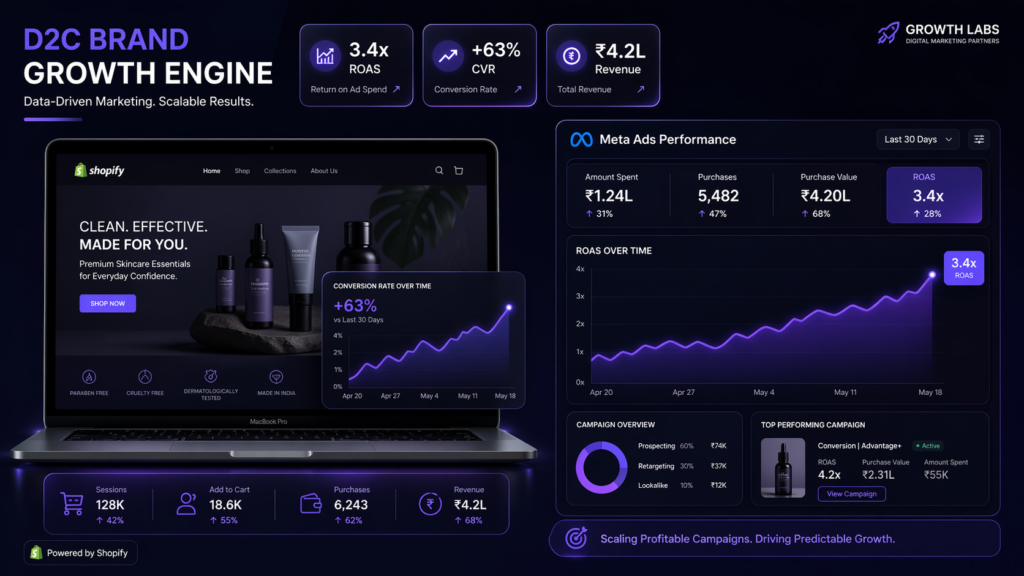
If you’re running a D2C brand in India right now, you already know the problem.
Traffic is coming in. You’re spending on ads. Your product is good. But the numbers — ROAS, conversion rate, repeat purchase rate — stubbornly refuse to match the effort you’re putting in.
The issue isn’t usually the product. It’s the system around it.
This guide breaks down exactly how high-growth D2C brands in India scale in 2026 — and what’s holding most brands back from getting there.
What Actually Drives D2C Growth
Before tactics, you need to understand the three levers that control every D2C brand’s revenue:
1. Traffic — Getting people to your store
2. Conversion — Turning visitors into buyers
3. Retention — Getting buyers to come back
Most brands over-invest in traffic and ignore the other two. That’s why their revenue flatlines even when ad spend goes up.
The brands that scale profitably? They work all three levers simultaneously.
Step 1 — Fix Conversion Before Scaling Ads
This is the single most important piece of advice we give every new client.
If your store converts at 1% and you double your ad spend, you’ll get double the sales — but you’ll also double your losses if your margins are thin.
Fix the store first. Then scale.
What CRO actually looks like for D2C brands:
- Heatmap and session recording analysis — where are people dropping off?
- Product page optimisation — are you answering every objection before checkout?
- Checkout flow audit — how many steps? How much friction?
- Mobile UX review — 70%+ of D2C traffic in India is mobile
- A/B testing — what headline, image, or CTA actually converts better?
A properly optimised store can go from 1% to 2.5% conversion rate. That’s 2.5x revenue from the same traffic, without spending a single extra rupee on ads.
What to check on your store right now:
- Does your product page have real reviews with photos?
- Is your add-to-cart button above the fold on mobile?
- How many clicks does it take to reach payment from the homepage?
- Is your site loading in under 3 seconds?
If any of these are broken, fix them before touching your ad budget.
Step 2 — Build a Paid Ads Machine That Scales
Most D2C brands in India run ads the wrong way.
They set up a campaign, watch it for a week, panic when ROAS drops, change everything, and repeat. This is not a strategy. It’s expensive guesswork.
A scalable paid ads system looks like this:
Meta Ads (Facebook & Instagram)
This is where most D2C brands discover new customers. But the key is not just running ads — it’s testing creatives systematically.
What works in 2026:
- UGC-style video ads (customers using the product)
- Problem-first hooks (“Tired of kids rejecting every toy you buy?”)
- Retargeting audiences who visited but didn’t buy
- Lookalike audiences built from your best customers, not all customers
Google Ads
High-intent buyers search Google. “Best silver jewellery under 2000 India”, “organic kids clothing online India” — these people are ready to buy.
Google Shopping campaigns are particularly powerful for D2C brands with clear product images and competitive pricing.
The Rule That Changes Everything
Your ads and your landing page must be aligned. If your ad says “40% off silver jewellery” and your landing page shows the full collection without the offer, you’ve wasted the click.
Alignment between ad creative and landing page is the single biggest driver of ROAS improvement we see across client accounts.
Step 3 — Build Your Store to Convert
Whether you’re on Shopify or WooCommerce, your store is your most important sales tool. Most D2C stores in India are leaving significant revenue on the table because of fixable technical and design issues.
For Shopify stores:
- Custom product pages that match your brand story
- Fast-loading theme (Core Web Vitals matter for both conversions and SEO)
- Bundle and upsell flows that increase average order value
- App stack: review widget + WhatsApp recovery + shipping tracker
- Checkout optimised for Indian payment methods (UPI, COD, EMI)
For WordPress/WooCommerce stores:
- Speed-optimised build (under 2 seconds target)
- CRO-focused landing pages for ad traffic
- Lead capture for brands with longer sales cycles
- SEO-ready structure from day one
The most common store mistakes we audit:
- No trust signals on the product page (no reviews, no badges, no return policy)
- Too many steps between product page and payment
- No urgency or scarcity (even simple “Only 8 left” works)
- Generic product descriptions that don’t sell
- No mobile-optimised images (blurry or slow-loading product photos)
Step 4 — Own Your Audience With Email & WhatsApp
This is the channel most D2C brands completely ignore — and it’s their biggest mistake.
Paid ads rent your audience. Email and WhatsApp own them.
When you have a customer’s phone number or email, you can reach them without paying for every impression. That’s the highest-ROI channel in D2C, by a significant margin.
The flows every D2C brand needs:
Abandoned Cart Recovery
70% of shoppers add to cart and leave. A well-timed WhatsApp message (“Hey, you left something behind — here’s 10% off if you complete your order”) can recover 35–45% of those carts.
Welcome Series
First impressions matter. A 3-part welcome sequence that introduces your brand story, your best products, and social proof converts new subscribers into first-time buyers consistently.
Post-Purchase Flow
The best time to sell to a customer is right after they’ve bought. A post-purchase sequence that thanks them, asks for a review, and offers a relevant product generates significant repeat revenue with zero ad spend.
Win-Back Campaign
Customers who bought 90 days ago and haven’t returned are your most valuable retargeting audience. A well-crafted win-back email or WhatsApp message costs almost nothing and converts far better than cold ads.
Tools we use:
- WhatsApp: AiSensy, Interakt
- Email: Klaviyo, Mailchimp
- Both integrate with Shopify and WooCommerce natively
Step 5 — Use Social Media as a Sales Channel, Not a Posting Schedule
Most D2C brands treat social media as a box-ticking exercise. Post three times a week, use trending audio, gain followers.
This is not a strategy.
Your social media should be doing three jobs simultaneously:
1. Discovery — New people find your brand
2. Trust — They decide your brand is worth buying from
3. Conversion — They click through and buy
Content that works for D2C brands in India (2026):
- Product in use — Real customers, real situations. Not studio photography.
- Behind the scenes — How the product is made, packed, delivered. Builds trust.
- Educational content — “3 things to check before buying silver jewellery online” — builds authority
- Reviews and testimonials — Screenshot and post them. Free content that converts.
- Comparison content — “Why our product vs generic alternatives” — works especially well for premium D2C
What doesn’t work:
- Generic “festival greetings” posts with your logo
- Stock photography
- Posting the same Reel template as everyone else
- Inconsistent posting (3 posts this week, nothing for 10 days)
Consistency and relevance beat virality every time.
The Full Picture: What a High-Growth D2C Stack Looks Like
| Layer | What It Does | Tools |
|---|---|---|
| Store | Converts traffic into buyers | Shopify / WooCommerce |
| CRO | Maximises conversion from existing traffic | Hotjar, A/B testing |
| Paid Ads | Drives qualified new traffic | Meta, Google |
| Email & WhatsApp | Retains and recovers customers | Klaviyo, AiSensy |
| Social Media | Builds brand trust and organic traffic | Instagram, Meta |
| SEO | Long-term free traffic from Google | Yoast, content strategy |
The brands that grow fastest in India aren’t doing all of this perfectly. They’re doing all of it consistently.
Common Mistakes That Kill D2C Growth
Mistake 1: Scaling ads before fixing the store
Pouring money into ads when your conversion rate is below 1.5% is expensive. Fix the store, then scale.
Mistake 2: No retention strategy
If your entire revenue comes from new customers, you’re on a treadmill. Every rupee of growth requires more ad spend. Retention breaks this cycle.
Mistake 3: Treating all channels as separate
Your ads, your social media, your emails — they should tell the same story. When they’re inconsistent, customers get confused and don’t convert.
Mistake 4: Measuring the wrong things
ROAS matters. But so does LTV (lifetime value), repeat purchase rate, and cost per acquisition across all channels — not just paid.
Mistake 5: Waiting for perfect
The brands that win are the ones testing constantly. Launch, measure, improve, repeat. The perfect product page is the one that converts. You’ll only find it by testing.
What This Looks Like in Practice
One of our clients — a women’s jewellery brand — came to us spending ₹60K/month on Meta ads with a 1.1x ROAS.
We didn’t touch the ads for the first two weeks.
Instead, we audited the store, rebuilt the product pages, added trust signals, fixed the mobile checkout, and set up an abandoned cart WhatsApp flow.
Conversion rate went from 0.9% to 2.3%.
Then we restructured the ad campaigns with aligned creatives and proper audience segmentation.
ROAS went to 3.4x within 45 days. Same product. Same budget. Different system.
That’s what a properly built D2C growth system looks like. See more of our client case studies →
Where to Start
If you’re overwhelmed by all of this, start with the highest-leverage action: audit your store’s conversion rate.
Open Google Analytics or Shopify Analytics. What percentage of visitors are buying?
If it’s below 2%, that’s your priority. Fix that before anything else.
If it’s above 2% but your ROAS is below 2.5x, look at your ad campaigns — creative, targeting, and landing page alignment.
If both are decent but revenue isn’t growing, you don’t have a retention system. Build one.
Not sure where your biggest leak is?
Book a free 30-minute audit. We’ll look at your store, your ads, and your retention setup — and tell you exactly where you’re losing money and what to fix first.
No pitch. No obligation. Just a clear, honest picture of where your brand stands.
Resultiq Digital is a performance-first digital agency for D2C brands in India. We work with clothing, kids product, and accessories brands to grow revenue through CRO, paid ads, Shopify development, and retention marketing.